LiveStatus vs Statuspage.io: An Honest Comparison (2026)
An honest comparison of LiveStatus and Statuspage.io covering pricing, features, and trade-offs. Find out which status page tool fits your team.
If you are searching for a Statuspage.io alternative, you have probably noticed that the market has changed since Atlassian acquired Statuspage back in 2016. New tools exist. Pricing models have shifted. And the feature gap that once made Statuspage the obvious default has narrowed considerably.
We built LiveStatus because we believed teams deserved a modern statuspage alternative that did not require a four-figure monthly bill to unlock the features that matter. But this is not a sales pitch disguised as a blog post. We genuinely respect what Statuspage built --- they defined the category --- and we want to give you a clear picture so you can decide for yourself.
Here is what we will cover: a feature-by-feature comparison, a detailed pricing breakdown, what Statuspage does better than us, what we do better than them, and a practical migration path if you decide to switch.
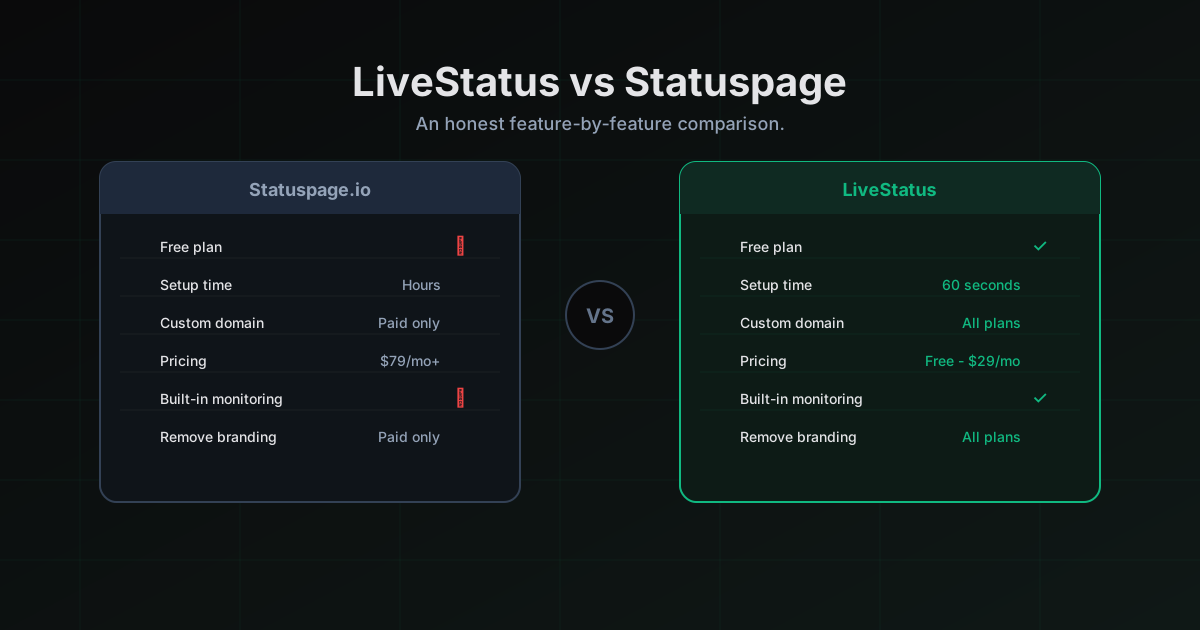
Quick comparison table
Before we get into the details, here is a high-level view of how the two products stack up across the features most teams care about.
| Feature | LiveStatus | Statuspage.io |
|---|---|---|
| Free plan | Yes (1 page, 3 services) | No (discontinued) |
| Starting price | $19/mo (Starter) | $29/mo (Starter) |
| Custom domain | Starter ($19/mo) | Growth ($99/mo) |
| Native mobile app (iOS + Android) | Yes, all plans | No |
| Push notifications | Yes, all plans | Email/SMS only |
| 5-minute uptime monitoring | Starter ($19/mo) | Starter ($29/mo) |
| 60-second uptime monitoring | Business ($149/mo) | Enterprise ($1,500/mo) |
| Multi-region checks | Pro ($49/mo) | Business ($399/mo) |
| SSO (SAML, Google, Okta) | Business ($149/mo) | Enterprise ($1,500/mo) |
| Email subscribers | Unlimited (Pro+) | 2,000 cap |
| Incident templates | Starter ($19/mo) | Growth ($99/mo) |
| Slack + Discord integrations | Starter ($19/mo) | Growth ($99/mo) |
| Audit logs | Business ($149/mo) | Enterprise ($1,500/mo) |
| API access | Pro ($49/mo) | Business ($399/mo) |
| Uptime SLA | 99.99% (Business) | 99.99% (Business) |
The pattern is consistent: features that Statuspage.io gates behind their $399/mo Business or $1,500/mo Enterprise tiers are available on LiveStatus at a fraction of the cost. But features alone do not tell the full story, so let us break this down further.
Pricing breakdown: tier by tier
Pricing is where the difference between LiveStatus and Statuspage.io becomes most stark. Both products offer tiered plans, but the cost per feature diverges significantly at every level.
Free tier
LiveStatus Free gives you 1 status page, 3 monitored services, 50 email subscribers, and manual incident management. It is a real product with real utility --- great for personal projects, side hustles, or evaluating the platform before committing.
Statuspage.io discontinued their free Hobby plan. There is no free tier. You either pay $29/mo or you look elsewhere.
Entry level: $19/mo vs $29/mo
LiveStatus Starter at $19/mo includes custom domains, 5-minute uptime monitoring, incident templates, and Slack/Discord integrations. Statuspage's Starter at $29/mo gives you a branded page and 5-minute monitoring, but custom domains, incident templates, and integrations are locked behind the $99/mo Growth plan.
That means you would need to spend $99/mo on Statuspage to match what LiveStatus offers at $19/mo. That is a 5x cost difference for equivalent functionality.
Mid-tier: $49/mo vs $399/mo
LiveStatus Pro at $49/mo unlocks multi-region uptime checks, unlimited email subscribers, API access, and webhook integrations. On Statuspage, multi-region checks and API access require the $399/mo Business plan.
At this tier, you are comparing $49/mo to $399/mo for roughly the same feature set. That is an 8x difference, or $4,200 per year in savings.
Top tier: $149/mo vs $1,500/mo
LiveStatus Business at $149/mo includes everything in Pro plus 60-second monitoring intervals, SSO (SAML, Google Workspace, Okta), audit logs, priority support, and a 99.99% uptime SLA.
Statuspage's Enterprise plan, which gates 60-second monitoring, SSO, and audit logs, starts at $1,500/mo and requires a sales call. That is 10x the cost. Over a year, the difference is $16,200.
For a startup or mid-size team, $16,200/year is meaningful. That is a senior engineer's annual learning budget, or six months of a junior developer's salary in some markets.
Why the price gap exists
We get asked this a lot: "How can you be so much cheaper? What's the catch?" The answer is straightforward. LiveStatus is built and operated by a small team at Leonenko Group LLC. We do not have Atlassian's overhead --- no 14,000-person org, no sprawling product suite, no enterprise sales team. Our infrastructure runs on Vercel's edge network and Neon Postgres, both of which scale efficiently. We pass those savings on because keeping prices low is how we win customers, and keeping customers happy is how we stay in business.
There is no catch. We are just smaller and more focused.
What Statuspage.io does better
We promised this would be honest, so here it is. There are real reasons to choose Statuspage.io over LiveStatus, and pretending otherwise would be dishonest.
Established brand and track record
Statuspage.io has been around since 2013. They are backed by Atlassian, a publicly traded company worth billions. When your CTO asks "who else uses this?", Statuspage can point to thousands of well-known companies. That kind of institutional trust takes years to build, and we are still early in that journey.
If your organization requires a vendor with a decade-long track record and a Fortune 500 parent company, Statuspage is the safer bet on paper.
Atlassian ecosystem integration
If your team already lives inside Jira, Confluence, Opsgenie, and the broader Atlassian suite, Statuspage integrates natively with all of them. Incidents can flow from Jira tickets. Opsgenie alerts can auto-create Statuspage incidents. Confluence pages can embed status widgets.
LiveStatus integrates with Slack, Discord, PagerDuty, and offers webhooks for custom workflows, but we do not have native Atlassian integrations. If Jira is the center of your incident management universe, that matters.
Larger template and component library
Statuspage has had years to build out their template library for status pages, incident templates, and maintenance windows. Their component system is mature and well-documented. We are building ours out rapidly, but Statuspage has a head start in sheer volume of pre-built options.
Enterprise compliance documentation
Atlassian provides extensive SOC 2, ISO 27001, and GDPR compliance documentation. For enterprise procurement teams that require specific certifications and audit reports, Statuspage comes with a compliance package that larger organizations expect. We are working toward SOC 2 compliance, but we are not there yet.
What LiveStatus does better
Now for the areas where we believe LiveStatus offers a genuinely better experience.
Native mobile app with push notifications
This is our biggest differentiator. LiveStatus ships a native iOS and Android app that lets you manage incidents, view uptime dashboards, and receive push notifications --- all from your phone.
Statuspage.io is web-only. There is no mobile app. When your production database goes down at 2am, a Statuspage user needs to open a laptop, navigate to the web UI, and post an update. A LiveStatus user gets a push notification, taps it, and posts an incident update from bed in under 30 seconds.
For on-call engineers and small teams where every minute of downtime matters, this is not a nice-to-have. It is the difference between a 2-minute response time and a 10-minute response time.
Real-time uptime monitoring included
Every LiveStatus paid plan includes uptime monitoring out of the box. We check your endpoints, track response times, and auto-detect outages. Monitoring is not an add-on or a separate product --- it is built into the core experience.
Statuspage.io treats monitoring as an add-on feature. Their basic plans focus on manual incident reporting. If you want automated monitoring, you either pay for a higher Statuspage tier or bolt on a separate tool like Pingdom or UptimeRobot. With LiveStatus, monitoring and status pages are one product.
10x cheaper at every tier
We covered this in the pricing section, but it bears repeating as a feature in its own right. At every comparable tier, LiveStatus costs roughly one-tenth of what Statuspage charges. For startups, bootstrapped companies, and teams watching their burn rate, this is a deciding factor.
Check our pricing page for the full breakdown, or visit our detailed comparison page for a side-by-side feature matrix.
Modern stack, modern experience
LiveStatus is built on Next.js, Postgres, and edge infrastructure. The UI is fast, dark-mode by default, and designed for the way teams work in 2026. Statuspage's interface has not changed meaningfully since the Atlassian acquisition. It works, but it feels like a product from a different era.
This is subjective, and we acknowledge that. But if you spend time in your status page dashboard every day, the experience of using it matters. We obsess over load times, animation smoothness, and information density because we use LiveStatus ourselves.
Unlimited email subscribers
On LiveStatus Pro and above, email subscribers are unlimited. Statuspage caps subscribers at 2,000 across all plans except Enterprise. If you have a large user base that wants email notifications for incidents, Statuspage's cap can become a real constraint --- and removing it means jumping to a $1,500/mo plan.
Migration from Statuspage.io
Switching status page providers sounds disruptive, but in practice it is straightforward. We have built a migration path specifically for teams coming from Statuspage.io.
Here is what the process looks like:
- Export your data --- Statuspage allows you to export your subscriber list as a CSV and your component/service structure via their API.
- Set up LiveStatus --- Create your status page, add your services, and configure monitoring endpoints. This takes about 15 minutes for a typical setup.
- Import subscribers --- Upload your subscriber CSV. Your existing subscribers receive a one-time notification about the new status page URL and continue getting incident updates without needing to re-subscribe.
- Update your DNS --- Point your custom domain (e.g., status.yourcompany.com) to LiveStatus. We auto-issue SSL certificates via Let's Encrypt.
- Verify and go live --- Confirm monitoring is working, send a test incident notification, and you are done.
Total time for most teams: about 30 minutes. If you are on any paid LiveStatus plan, our team will help you migrate manually at no extra cost.
For a detailed walkthrough, see our migration guide.
The verdict
We are biased --- we built LiveStatus --- so take our opinion with appropriate skepticism. But here is how we genuinely see it:
If you need deep Atlassian ecosystem integration, Statuspage.io is the safe choice. If your team runs on Jira, Opsgenie, and Confluence, and those integrations are non-negotiable, Statuspage fits naturally into that workflow. The premium you pay is the cost of staying inside the Atlassian universe.
If you need enterprise compliance documentation today, Statuspage has the SOC 2 and ISO 27001 certifications that procurement teams require. We are working on ours, but we are not there yet.
For everything else, LiveStatus gives you more for less. A native mobile app that Statuspage does not have. Push notifications that get your team responding faster. Real-time monitoring built in rather than bolted on. And pricing that is 10x lower at every comparable tier.
We are not trying to be Statuspage with a lower price tag. We are building the status page product we wished existed when we were evaluating options ourselves --- modern, mobile-first, and priced for teams that would rather spend their budget on building product than on vendor bills.
Try LiveStatus free
The best way to evaluate any tool is to use it. Our free plan gives you a real status page with 3 monitored services and 50 email subscribers. No credit card required. No trial expiration. Set it up in 5 minutes and see if it fits.
If you want the side-by-side feature matrix with checkmarks and tier labels, check out our comparison page. If you are ready to move off Statuspage.io, our migration guide walks you through it step by step.
Questions? Reach out at support@livestatus.dev. We read every message.
More posts
The Best BetterStack Alternative in 2026: LiveStatus
Looking for a BetterStack or Statuspage alternative? LiveStatus gives you beautiful status pages and uptime monitoring without the enterprise price tag.
Why Every API Provider Needs a Status Page
API providers without a status page are leaving developer trust on the table. Here's what a proper API status page does, what it covers, and why it reduces your support load while your incidents are still in progress.
How a Status Page Cuts Support Tickets by 40%
The math behind how a status page reduces support ticket volume during incidents. Email subscribers, SMS alerts, proactive communication, and why the ROI shows up in your support metrics within the first incident.